A Memory Company Is About to Print 80% Margins. What this says about the future economics of the memory industry.
A memory company reporting gross margins approaching ~80% would, not long ago, have read like a typo rather than a serious statement about the current memory industry economics. This is the kind of margin profile you expect from a software business that writes code once and sells it a million times at no marginal cost, not from one that runs multi-billion-dollar fabs and ships physical silicon. Memory was the commodity corner of semiconductors, the business that lost money in bad years and made a little in good ones. The question worth asking on Wednesday isn't whether the margin is real. It's whether a company this capital-intensive gets to keep a software company's economics, or whether this is the top of another cycle.
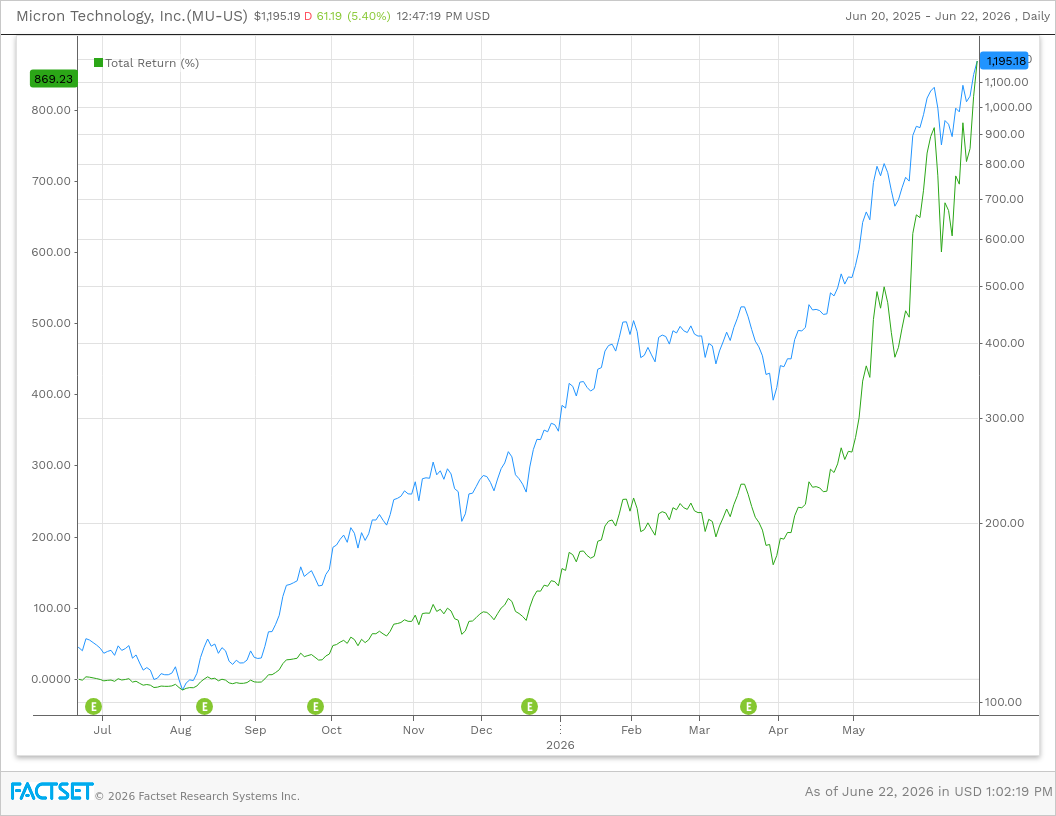
The market has already begun to re-rate Micron, with the stock up roughly eightfold over the past year and crossing $1 trillion in market value in late May. It has moved from a classic cyclical semiconductor name to one of the defining beneficiaries of the AI infrastructure buildout, as investors reassess whether memory is still a purely cyclical business.
Micron reports fiscal Q3 on June 24, after the close. My outlook remains broadly constructive for a simple reason: hyperscaler capex is real, it is already committed, and a large share of it has nowhere to go but memory. But "the quarter will be good" is the least interesting thing I can say right now, because everyone already knows it. So this is less a prediction and more a list of what I'll be reading the tape for, from the seat of someone who has shipped storage product rather than someone modeling a target price.
What Micron Actually Sells
Most write-ups open with a tidy list of divisions. I'd rather start with where the money actually comes from, which is the product.
Micron makes DRAM and NAND, plus a bit of NOR flash. DRAM is roughly 80% of revenue, so however you slice the org chart, this is a DRAM-and-HBM story first and a NAND story second.[1] The portfolio that sits on top of those two technologies is the part worth knowing: HBM, GDDR, LPDDR, managed NAND, enterprise and consumer SSDs, and the Crucial-branded modules you can buy yourself.
If you want the go-to-market overlay, Micron now runs four business units:
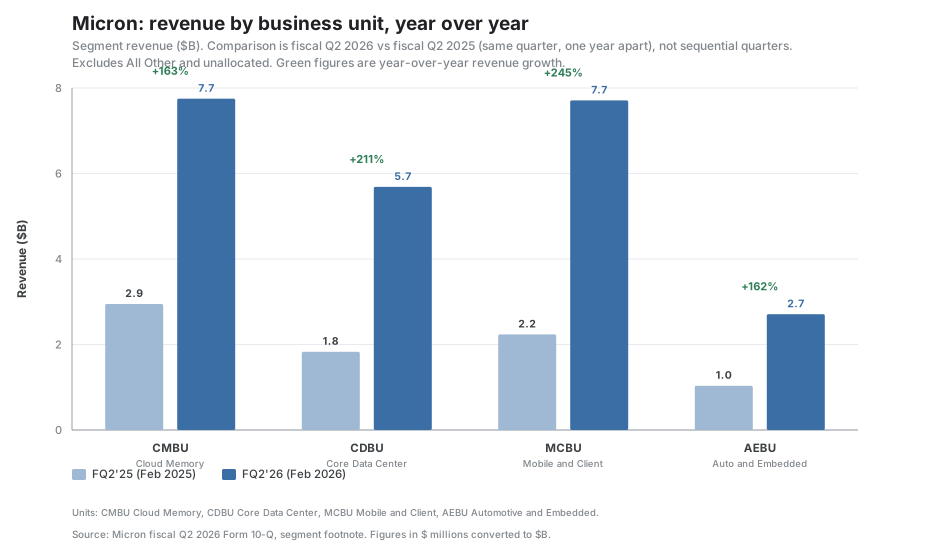
- Cloud Memory Business Unit (CMBU): memory solutions for large hyperscale cloud customers, and HBM for all data center customers.
- Core Data Center Business Unit (CDBU): memory solutions for mid-tier cloud, enterprise, and OEM data center customers, and storage solutions for all data center customers.
- Mobile and Client Business Unit (MCBU): memory and storage solutions for the mobile and client segments.
- Automotive and Embedded Business Unit (AEBU): memory and storage solutions for the automotive, industrial, and consumer segments.
Here is how revenue splits across those four units, and how each grew over the past year:
Annual Revenue Trends
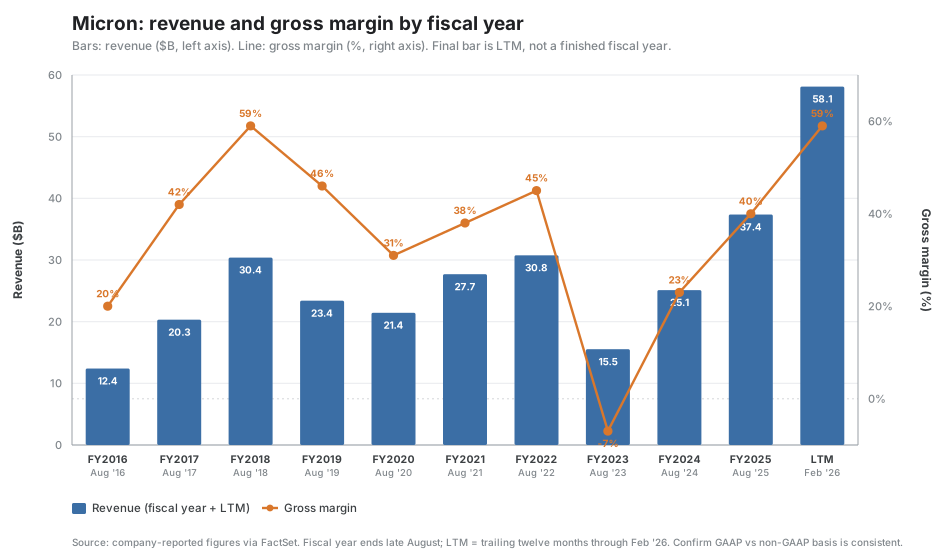
The trajectory is difficult to ignore. Revenue went from $15.5 billion in fiscal 2023, a year Micron posted a net loss of nearly $6 billion, to $25.1 billion in 2024, to $37.4 billion in 2025.[2] Hold onto that 2023 trough. It matters as much as the peak, and I'll come back to it.
Quarterly Revenue Trends
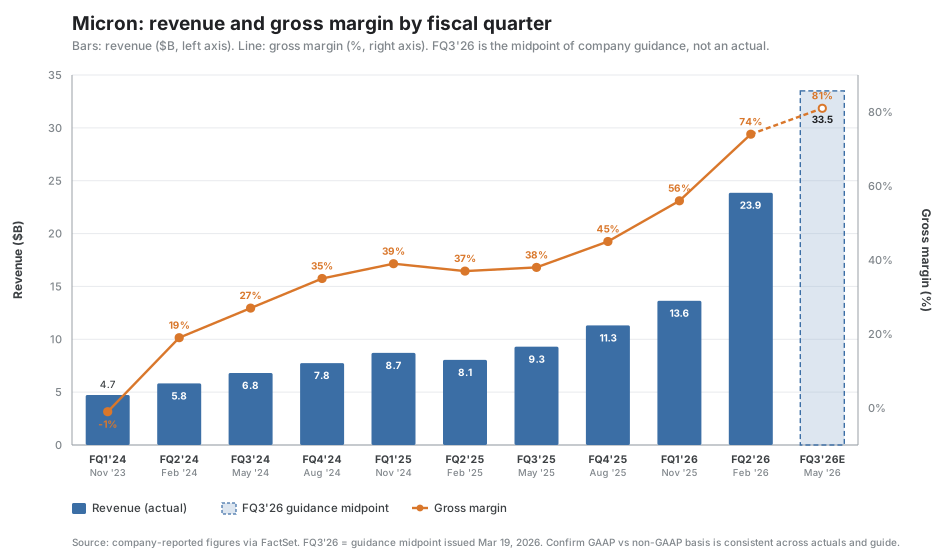
Most recent print, fiscal Q2 2026: $23.9 billion in revenue, gross margin around 75%, operating margin comfortably north of 60%. For Q3, management has guided revenue to around $33.5 billion and gross margin to roughly 81%.[1]
Why HBM Matters More Than Market Share
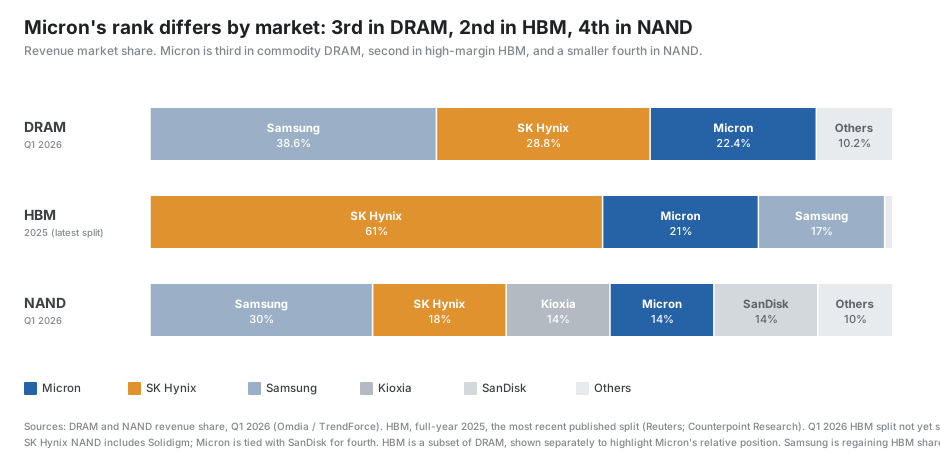
Micron's rank tells you more than its size. In commodity DRAM it sits third, behind Samsung and SK Hynix, and in NAND it is smaller still, tied for fourth.
But in HBM, the stacked memory that feeds AI accelerators and sits at the most profitable end of the memory market, Micron has climbed to second, ahead of Samsung and behind only SK Hynix. Nvidia has also qualified all three suppliers, Micron included, for HBM4 on its next-gen Vera Rubin platform.[3] The ranking tells a more nuanced story than the headline market-share figures suggest. Micron is not the largest memory supplier, but its strongest position is in HBM, where industry profits are increasingly concentrated. The caveat is that HBM is also the industry's most contested market, with Samsung investing aggressively to regain share, making Micron's position valuable but far from secure.
Where We Are in the Cycle
The demand side is straightforward. AI servers, hyperscaler buildouts, and cloud providers locking in supply through long-term agreements rather than buying quarter to quarter.
Additionally, Anthropic named Micron alongside Samsung and SK hynix as strategic infrastructure partners in its Series H $65 billion funding round, citing their role in the memory and storage it needs to scale compute.[4] The release does not quantify what Micron gets out of it, so I read it as a signal rather than a number.
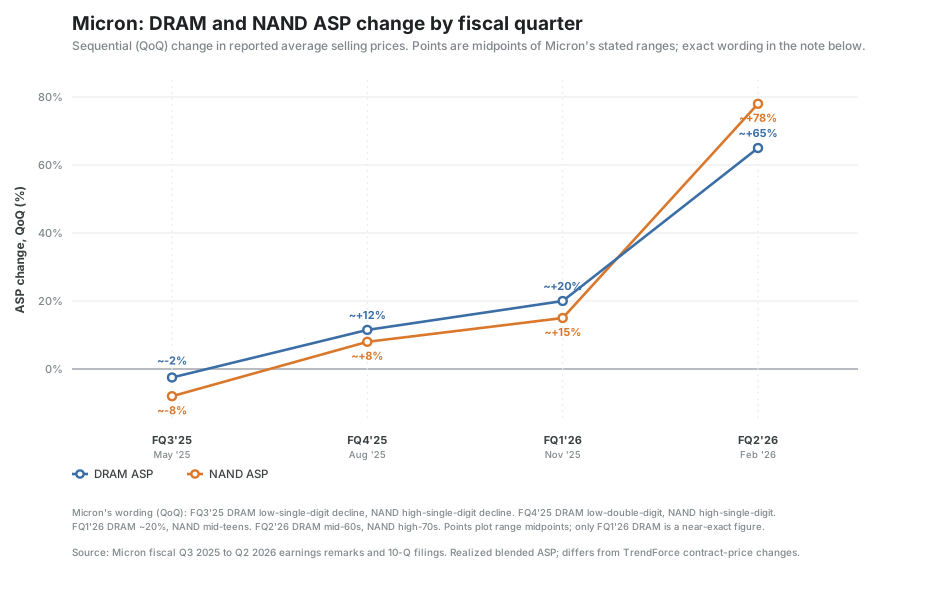
Over the last two quarters, DRAM contract prices roughly tripled and NAND more than doubled.[5] And here is the non-obvious bit: in Q2, NAND's quarter-over-quarter increase actually outpaced DRAM's for the first time this cycle. That crossover is easy to miss and worth flagging, because NAND has been the junior partner in this rally and it just changed seats.
 How long does it last? TrendForce expects the shortage to run through 2026, with meaningful new capacity unlikely to come online before late 2027 or 2028.[5] Fabs take years to build.
The Shortage Is Escaping the Data Center
One of the more interesting developments this cycle is that the shortage is no longer confined to hyperscalers. The institutional story is well known by now, what matters is whether those pressures are beginning to show up elsewhere.
There are signs that they are.
GPU vendors have re-released older-generation products simply to maintain inventory on shelves.[6] Memory prices across consumer channels have moved sharply higher, with PCPartPicker data showing meaningful increases across DRAM modules and storage products over recent quarters.[7][8]
The pressure has even reached some of the industry's largest buyers. Apple CEO Tim Cook recently described the current environment as a "hundred-year flood," noting that memory costs are rising in ways he has not seen in decades.[9]
None of this changes the core investment thesis. Hyperscaler demand remains the primary driver of the cycle. But it does suggest that tightness is propagating through the broader ecosystem rather than remaining isolated to AI infrastructure.
What I'll Be Watching on Earnings Day
Mainly, four things:
1. The guide versus the whisper, not the beat. Micron will almost certainly beat. That's nearly priced in. The real test is whether the next-quarter guide clears a bar that has crept higher every week. Two weeks ago Broadcom showed exactly how this goes wrong. EPS came in ahead, and the company's total revenue guide for the coming quarter actually topped consensus. The stock still fell about 13% the next day, because the AI-chip line specifically landed light against an inflated whisper number, and management reiterated rather than raised its full-year AI target.[10] I'm watching for the same dynamic.
2. The DRAM/NAND crossover. Does NAND keep outpacing DRAM into this print? It will be interesting to see whether the trend holds or DRAM reasserts itself. It will also be an early read on SanDisk, a pure-play NAND maker that reports soon after.
3. Margin durability. The guide is about 81% gross margin, and I'll be looking forward to seeing whether they actually deliver it, and what the forward guidance says.
4. Contract momentum. More multi-year agreements would feed the structural story and build confidence in the company going forward.
Has AI Changed the Memory Cycle?
The bull thesis right now is that this time is different. Long-term agreements plus sold-out HBM have structurally bent the memory cycle, so the boom-and-bust pattern that defined this industry for forty years no longer applies. Demand is secular, not cyclical.
I want to be fair to that case because parts of it are strong. The contracts are real. The capacity timeline is real. AI demand does not look like a head-fake.
But here is the other side, and it's the number I told you to hold onto: in fiscal 2023, this same company lost nearly $6 billion. Not in 1998. Three years ago. Memory has crashed hard and repeatedly, and the last time cloud buyers became the dominant force, they over-ordered and the cycle turned within a year. The bull case rests on multi-year contracts being a new kind of moat. The bear case is simpler: this industry has watched durable-looking demand evaporate before, and the contracts are mostly new and largely untested through a real downturn.
What's Next
On the 24th I'll be reading for the guide against the whisper, the NAND-versus-DRAM trend, and whether management sounds as confident about next quarter's margins as they do about this one's.
This is my own analysis as a product person, not investment advice. No price target, no recommendation, just what I'm watching and why.
Footnotes
-
Micron Q2 Earnings 10Q_. (n.d.). [Data set]. Retrieved https://www.sec.gov/ix?doc=/Archives/edgar/data/0000723125/000072312526000006/mu-20260226.htm ↩ ↩2
-
Micron 2025 Earnings 10K_. (n.d.). Retrieved https://www.sec.gov/ix?doc=/Archives/edgar/data/0000723125/000072312525000028/mu-20250828.htm ↩
-
Farooque, F. (2026, June 5). Nvidia qualifies three hbm4 suppliers for vera rubin ai platform. Yahoo Finance. https://finance.yahoo.com/sectors/technology/articles/nvidia-qualifies-three-hbm4-suppliers-123240769.html ↩
-
Anthropic raises $65B in Series H funding at $965B post-money valuation_. (n.d.). Retrieved 22 June 2026, from https://www.anthropic.com/news/series-h ↩
-
James, L. (2026, April 1). DRAM prices predicted to jump 63% in Q2, NAND up to 75%—Follows 95% jumps in Q1, Trendforce says AI server demand keeps supply tight. Tom’s Hardware. https://www.tomshardware.com/pc-components/dram/dram-and-nand-contract-prices-to-climb-again-in-q2 ↩ ↩2
-
Liu, Z. (2026, June 11). Memory famine compels GPU vendors to re-release 2020 graphics cards—GeForce RTX 3060 and GeForce RTX 3050 return to Asian market. Tom’s Hardware. https://www.tomshardware.com/pc-components/gpus/memory-famine-compels-gpu-vendors-to-re-release-2020-graphics-cards-geforce-rtx-3060-and-geforce-rtx-3050-return-to-asian-market ↩
-
Storage Price Trends (n.d.). Retrieved https://pcpartpicker.com/trends/price/internal-hard-drive/ ↩
-
Memory Price Trends (n.d.). Retrieved https://pcpartpicker.com/trends/price/memory/ ↩
-
Winkler, R. (2026, June 17). Apple to raise prices due to memory-chip shortage, CEO says. The Wall Street Journal. Quote also reported by ABC News: https://abcnews.com/Business/tim-cook-prices-apple-devices-jump-amid-memory/story?id=133996174](https://abcnews.com/Business/tim-cook-prices-apple-devices-jump-amid-memory/story?id=133996174) ↩
-
Ines, F. (2026, June 4). Broadcom stock sinks 12% as AI chip forecast disappoints. Yahoo Finance. https://finance.yahoo.com/markets/article/broadcom-stock-sinks-12-as-ai-chip-forecast-disappoints-165602082.html ↩